
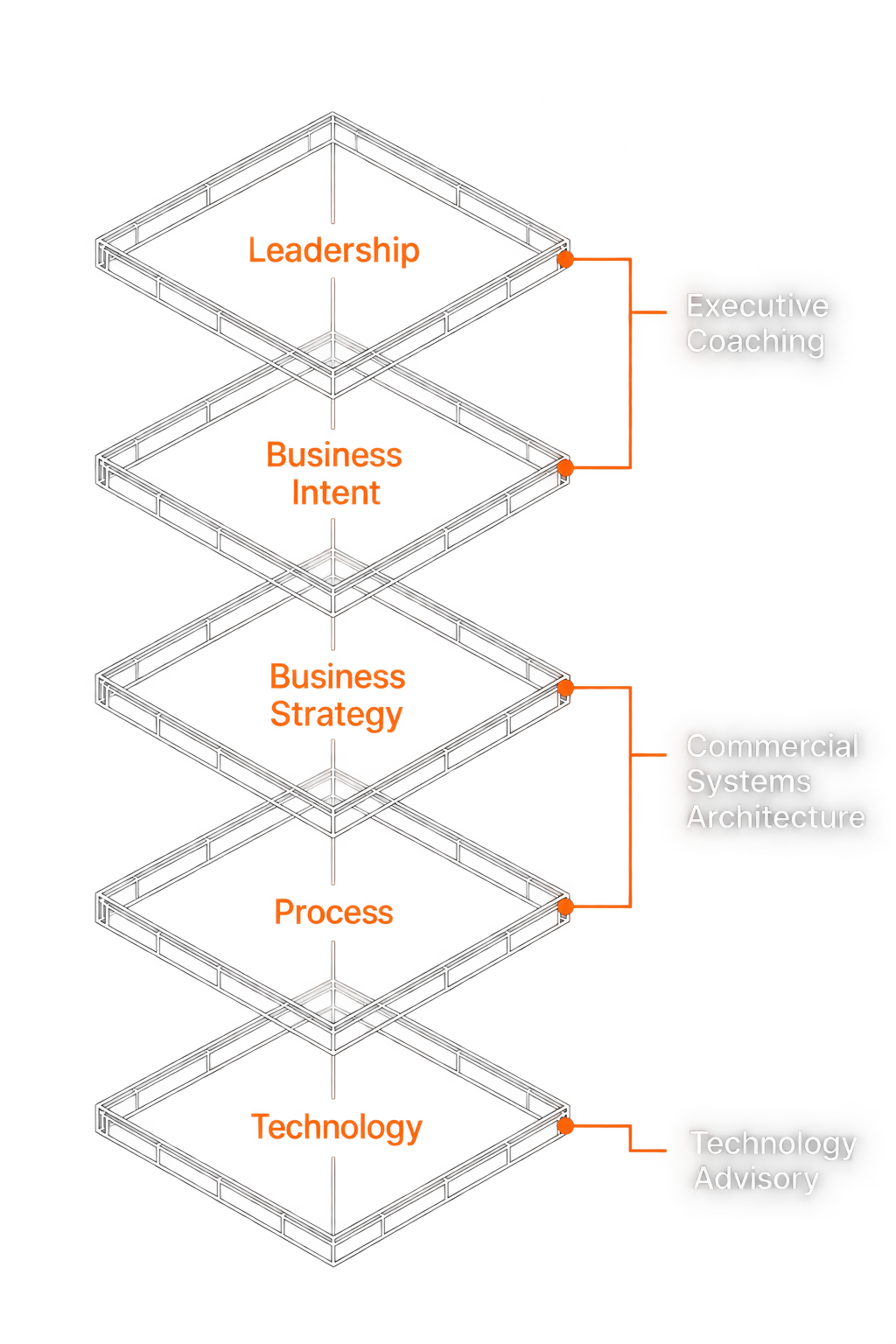
Commercial Systems Architecture
Turn clear Business Intent into the Business Strategy and operating architecture required for coherent execution across Marketing, Sales, Service Delivery, Learning & Enablement, and Business Intelligence.
Tell Firefly Consulting what you needCommercial Systems Architecture connects Business Intent with Business Strategy and how that strategy is executed.
Once the business is clear about what it is trying to accomplish and why, Commercial Systems Architecture defines what the business will do and how it must operate to do it.
Commercial Systems Architecture defines the business architecture. Technology Advisory determines what technology is required to support it.
Strategy turns Business Intent into choices.
What objectives matter?
What will the business pursue, and what will it deliberately not pursue?
Where should resources go?
What priorities and tradeoffs follow from the Business Intent?
What assumptions materially affect those choices?
Strategy makes those decisions explicit so the rest of the business has clear direction.
Process turns those strategic choices into execution.
Who owns what?
How are decisions made?
How does work move?
Where are the handoffs?
How are exceptions handled?
What gets measured?
Process defines how the strategy actually operates across the business.
Business Architecture First. Technology Second.
Businesses often arrive asking about technology first, but you have to solve the system before you buy the software.
You do not need a CRM until you know how you sell.
You do not need a project management system until you know how projects should be managed.
You do not need automation until you know what should happen, when it should happen, who owns it, and what outcome it should produce.
Technology should support the business architecture, not compensate for the absence of one.
One business. One architecture.
Marketing, Sales, Service Delivery, Learning & Enablement, Business Intelligence, and Connectivity each have their own strategies and processes.
They still have to operate as parts of the same business.
Commercial Systems Architecture aligns them to the Business Strategy and defines the ownership, decisions, workflows, handoffs, measurement, and governance required to execute coherently.
Common signals that the architecture needs work:
"We have too many priorities and do not know what to say no to."
"Our leaders are pulling the business in different strategic directions."
"We have initiatives and plans, but they do not add up to a coherent strategy."
"We have a strategy, but do not know which assumptions it depends on or whether they are true."
"The handoff from Sales to delivery is broken."
"Nobody sees the entire customer journey."
"Our systems do not work together."
"We have outgrown spreadsheets and disconnected tools."
What changes when the architecture is clear:
A coherent Business Strategy.
Explicit priorities and tradeoffs.
Functions aligned to the same strategic direction.
Clear ownership and decision rights.
Processes that reliably execute the strategy.
Measurement tied to what the business is trying to accomplish.
Technology requirements derived from the architecture instead of selected first.
Your business should operate as one system.
Commercial Systems Architecture turns Business Intent into a coherent strategy and an operating architecture capable of executing it.
Tell Firefly Consulting what you need